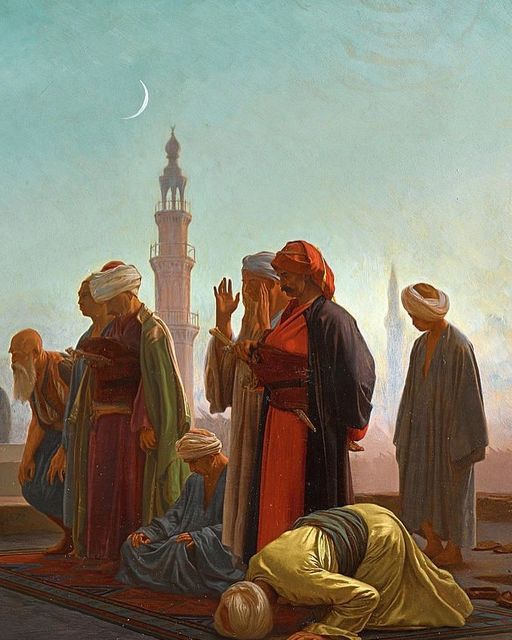
Salah is the most imporatant action
Salah is the most important after sahadah, Salah is the daily ritual prayer for Muslims which is 5 times a day each day at specific times throughout the day and this is something that has a basis within the Quran and the Sunnah. The Quran references prayer many times regarding its time place and how its to be done and within the Hadith (Preserved Sunnah) it expounds upon the details of how it is preformed in great detail and the Islamic scholarship teaches the Muslims and trasmits the information generation to generation in books just like this book Muqadimma al Izziyah. According to Islam Allah created man (and Jinn) for the purpose of worshiping him alone,
“I did not create jinn and humans except to worship Me.”
(Quran 51.56)
so whoever deprives himself of prayer has deprived himself of his purpose of creation and this will leave him with a depressed empty life.
“But whoever turns away from My Reminder will certainly have a miserable life,1 then We will raise them up blind on the Day of Judgment.””
Quran 20:124
Salah has 5 conditions
- you must be Muslim
- you be of age (not a child under 7)
- You must have a sound state of mind
- You must not be in a state of menstruation or post birth bleeding
- The Time of prayer must have entered
Ruling on the one who does not pray
For he that does not wants to pray, denies it or the 5 pillars of Islam or what is known by necessity he is a kafir and he has 3 days to repent or else he must be killed by the legitimate Islamic authorities. There are some instances in which after repentance the perpetrator is still killed such as claiming to be a prophet and its worth noting The Maliki madhab is stricter upon executing those who have apostated from the religion more so than other madhabs such as the Shafi’i or Hanbali who give the sinner/kafir more time to return to Allah but the Malikis beg to differ and want to remove you quicker
Why is the murtad given capital punishment?
The Muslims are a political community who was at risk of being annihilated and for you to apostatize it would be assumed in the classical understanding that you would then become a enemy of Islam and Muslims who can harm and share the secrets of the Muslims. Some modern elema agree that murtads should still be killed in the modern day. The one who says that a prayer is obligatory and refuses establish prayer even once while being encouraged to do so is to killed, as for children they must began to pray at 7 and you can hit them to coerce them to pray by age 10 and get them used to praying as youngsters , this ruling also applies to your wives, you are allowed to lightly strike them provided that its not in the face nor does it leave a mark to force your wife to pray and coerce her to follow the rulings of Islam.
There are 5 prayers within Islam
- 1. thuhr,
- 2. suhor/subh (fajr),
- 3. asr
- 4. maghreb
- 5. isha
Which prayer of the 5 ordained was revealed first?
The thuhr prayer was the first prayer revealed to the Prophet ﷺ that he prayed with Gabriel, before Allah revealed the 5 daily prayers the Muslims would pray 4 rakat a day instead of 5 daily prayers.
Difference between Ikhtiyari and dharuri times
Every prayer has its ikhtiyari and dharuri times. Daroora (Necessity) means a time after which one can pray without being considered late and iktiyari means the chosen time window in which to pray under normal circumstances
Thuhur means the suns meridian (Directly above you). Fajr means before the sun rises and reaches the horizon. Asr is until when the sun has begun to set its prefered to pray before it becomes yellow, Maghreb is until twilight has faded and isha is until midnight. A interesting fact is that the dharuri time for fajr and asr is the same and that is something very unique! A takhir on delaying prayer until dharuri time, Whoever delays a prayer to its dharuri time without a valid excuse has sinned,
what are the 7 valid excuses to miss the dharuri time of prayer?
- 1.Menstration, post partum bleeding,
- 2.Kufr (becomes kafir and becomes Muslim again by time of prayer),
- 3.being underage, a youth under the age of 7
- 4.insanity (psychosis), unsound state of mind
- 5.fainting (losing consciousness),
- 6.Sleep, and forgetfulness
What if you miss the Dharuri time of prayer?
- If you realize that you should pray the dharuri and you have at least 1 rakat left of that other prayer, if you don’t have that time then its not obligatory on you. If you realize you should pray the dharuri of asr and you only have time for 1 rakaat before maghreb what would you do? If you didn’t pray asr then you would be late for asr you need at least time for 1 raakat of asr until next prayer is coming in, you need 5 rakaat time for what come before asr or that would be missed and asr late. As for sleep if you believed that you would be awake when the proper time arrived, or you had believed someone would wake you up then if you missed the iktiyari time then you can pray the daroori time. If you fell asleep due to an intoxicant then this would not be the case and your prayer would not be accepted due to that.
Repayment of missed prayers
Its fard to make up the missed fard prayers. With tarteeb with order you must make them up as they were supposed to be prayed, without any time limits or restraints. If you missed thuhr and asr you cannot do asr first you must start at asr, if you missed a entire day of prayer then you must start at suhr first until you reach isha or else you have harmed yourself. If you missed a prayer then you prayed the next prayer you must remake up the missed prayer and what came after (missed fajr then prayed thuhr you must remake it both up). Missing prayers has its penalties and it is sinful when you miss prayers and not make them up. Some have different opinions that you do not have to make up the prayer again but the author of the izziyah believes the 2nd prayer must be done again. If you remembered you missed a prayer while in the midst of the following prayer then that prayer becomes invalid and you must make it up again starting from the initial missed prayer.
Walking into jummah before ruku and the leader of prayer or the ma’mun
If you walk in on a jammah before they do ruku then you can join in but if they put hands upon knees then you did not catch that prayer. Lets say you are the imam of a jumah and you forgot that you missed a previous prayer then you are obliged to cease that prayer as your prayer and whoever prays behind you is not valid. If you are the ma’mun (He who praying behind) then you don’t run off once you realize you forget a prayer you continue praying in the jamaa until prayer is over then you make up the previous prayer and the current prayer provided you have a valid excuse.
The circumstanced which make prayer haram
There are a few circumstances in which salah is haram, when the sun is rising(The sun when rising its sight level where as when its in the air its above you and not in your sightline), (theres a hadith of not praying when rise has risen in its direction because it appears to worshiping the sun audubillah), And right when the sun is setting, jummah khutbah, praying while the khutbah has commenced (tahitul masjid), when the time has finished for one who still owes that prayer -if you missed thuhr you should not be praying your sunnah prayers nawfl its sinful and Allah is not pleased when you pray sunnan but not fard prayers.
When praying is disliked but not forbidden
Now we will list time when the prayers is disliked but not haram, when the sun of fajr is near to rising but not sight level, after asr it is dislike to pray nawafal then, when the athan of jummah (khutba?) is called for a person who is sitting down. After jummah is prayed and you pray your sunnah prayers in the same spot. In the maliki madhab its disliked to pray again in the same spot after jummah you should leave and not pray your sunan in the same spot. The disliked parts of prayer also apply to children, children are addressed even though they are not addressed by obligation but they are addressed by the disliked things in the prayer (sheikh dusuqi and others said this) Children had takleef but not in the wajibibat. Ibn abdil barr, imam malik and abu hanifah and their companians (ibn qasim for malik, ibn yusuf for shaybani and Sufyan al thawri, Qadi iyad and the salaf and tabi’in all agreed upon not praying during the khutba. When the khutba is going on do not pray listen to the khutba.
The Athan
The Athan is a sunnah not a fard for the prayer to be accepted, we all pray alone at home without a athan or within a small gathering only a iqama in that instance. Whats the difference between a jamia and a masjid? A Jamia comes from the word jummah a jamia is a large masjid where jummah is held (the largest central masjid) and a masjid is a place of prayer to be held but not the central masjid. A city should have one large jamia in theory not many, it should be the oldest and once its established it should remain for that use. In some instances there can be more than one jamia due to population size or city administration laws, in a city like new York each bourough should have its own jamia to gather all the Muslims for jummah in that city or admistrative area (In example the jamia in tunis would be qayrawan that has been expanded many times). Linquistcally the athan refers to the announcement of something, sheikh Sharnubi said it is a sunan kifayah which means it can be fulfilled by one person and that would lift the burden from others we do not all need to do a athan. The jummah has one khateeb and one imam and we are all obliged to participate in the prayer, the athan is something we should do despite not being fard and is one the the greatest shi’ar (public symbols and signs of Islam) of Islam. A story from Christian missionary work said that near the French consulate that there was a athan playing with a exquisite voice, the imam fired him from the postion of that muadthan athan and he said to that imam thank you for firing him for if you had not that ambassador would have convered to Islam and you firing him saved us from a lot of emberassment.
When you do the shadah for the 2nd time in the athan you should be louder than the first time you declared it. If your doing it for subh you add “prayer is better than sleep” also its worth noting the language of the athan is notable that it says hiyyah al salah which means to hasten to prayer or hasten towards salvation. The last point in the athan is that sheikh shanubi mentions extending praise upon the prophet after salams is a bidah but a bidah hassanah and a example of bidah hasanah is tarawih. In some small masjids they send salam upon the prophet and read hadith together. Someone who is traveling alone should do the athan to himself aloud despite being alone then no jinn or person or tree would hear your voice that would not testify on the day of judgement.
Maliki fiqh notes (Other lessons done before over phone while in tunis)
There are 18 sunnan of prayer
- 1. reciting Quran, There is no salat without the recitation of the fatiha you must recite this in every prayer.
- 2. Standing up for the recitation provided you are not cripple and unable
- 3. Reading aloud the first two rakaa of mughreb and isha and the whole subh shaf and witr jummah the two id prayers midnight and when it rains.
- 4. Reciting silently in the others and there is no harm if the worshiper reads a verse of two aloud when it is supposed to be silent. If you read more than a few verses then you should read the fatihah but if you have moved forward and now you are in bowing position then you do not backtrack and start over again provided he did not purposely go against the sunnah but he made a mistake. (the mutamid is that you do not have to redo your prayer even if you omit a sunnah accidently)
- 5. All takbirat except the commencement of prayer are sunnah acts
- 6. The first sitting of a prayer that requires two major sittings
- 7. The First Tashhud
- 8. The 2nd Tashhud
- 9. “Peace be upon us and the rightious servants of Allah I beard witness there is no….”
- 10. Invoking blessing upon the prophet in the tashahud
- 11. Saying “Allah hears who praises him”
- 12. responding to the salam of the imam
- 13. responding to the salam from the worshiper on the right
- 14. Saying Salam aloud
- 15. lestning tot he imam who recites loudly
- 16. Dont allow people to pass in front as you pray
- 17. Sitting in excess for the utterance of Taslim
- 18. A bit of increase of what is requirded of calmness
All takbirat are sunnah except takbir of ikram
The 6th is that you sit twice in the prayer
The first tashahud while you are sitting
The 2nd tashahud
Recite these words while in the tashahud
Invoking blessings on the prophet in the last tashahud
You raise your two hands when your doing takbir ikram, say Allahu akbar, takbir ikram is fard and doing rafa yaddan while raising hands is a fadila not fard. The length of recitation you do in each prayer, you recite long chatpers or sections of chapters during subh and thuhr and you do short ones for asr and maghrib and medium ones for isha. The 2nd rafa’a should be shorter than the first raka’a. The way to keep track of this is that the Quran is generally ordered from longest to shortest chapter, surah kawhtar is the shortest chapter of the Quran ( I think so). Abu qutadah reported from the prophet regarding these issues. You say Lord praise is due to you after saying Allah hears those who praise them. Its reported from musil al ashari that hadith.
Saying amen during the fatiha and the Qunut
You say amin after fatiha is recited silently and not aloud and then you make the A in Amin elongated more than the rest of the word. Regarding the recitation of qunut you recite it after the 2nd rakaat before ruku silently. Your Hands reach the ground ground first then your knees and when you get up your knees leave the ground first then your hands last to leave the ground. Khinser (Pinkey) and binser (next to pinky) and
Makruhat in salat (prayer)
To make dua right after the takbir ikram, likewise during your ruku’ in 2nd sitting your supposed to sit for awhle and make dua. Reciting the basmallah is disliked but prayer is still valid in the maliki madhab we do not recite the basimllah but starting with alhumdullilah rabil alameen. Imam al maziri was from sicaly that he would recite the basmallah silenetly in all of his prayers then he would out loud recite the fatihah, but generally you do not recite the basamallah. Praying on a carpet or a scarf in other words a woven thing that people walk on a lot that’s not for the purpose of prayer a edge of cloth the prayer is valid just mukru aka unideal but prayer is valid. (The prayer rug is known to be clean and that’s why its used for prayer), If your eyes are wondering around the room the prayer is valid but disliked, if your looking around and physically turn your head it is disliked. If you fear physical danger of a attack from y our enemy you can look around the room there is hadith about looking around and this is from shaytan to distract people from prayer.
Tashbeek is interlinking your fingers and farqa’a is cracking of the knuckles.
Doing tashbeek or farqa’a is mukru it does not invalidate the prayer but it is mukru, Shiekh shanoobi says praying in qabd position is valid but disliked in the maliki madhab as praying in sadl is the preferred way to in the maliki madhab it’s the mashur opinion and many jurist preferred the qabd within the madhab. Your not supposed to do many actions and movements in the prayer other than the approved of agreed upon movements. Other disliked things is playing with your ring or beard or fiddling with something like loose thread the prayer is valid but disliked. Closing the eyes is disliked your eyes should look at the place of prostration and do not look up towards the sky.
The feet and state of mind during prayer
The feet should not touch together during the prayer nor putting hands upon the waist during prayer. To not think about wordly matters but to have khushoo in prayer and if your unsure of the number of rakaat you have prayed then you have build off what your certain about, if you know you prayed 3 and not sure if you prayed a 4th then you pray once more. Carrying something in your sleeve or mouth while praying. Praying in a place where many people walk or movunvor through. Lastly Killing fleas and lice while in the masjid, sheikh al lakhmi says its fine to kill fleas while praying others says its disliked but wont break your prayer.
Invalidators of salah
What invalidates the prayer is as follows, Leaving out one of the conditions of the prayer without having a reason not to do it. Missing out on any of the arkam of the prayer like takbir ul ikram or doing it while a kafir. Leaving out a sunnah with being able to do it can invalidate the prayer according to some imams. Talking without any valid reason while fixing the prayer islah (Valid reasons you can speak while praying is when the imam make a mistake in Quran). Doing lots of actions which is not part of the prayer invalidates your prayer, your allowed to move if there is a gap in the prayer line or if you need to adjust your garment quickly or quickly make a scratch as long as it not a excessive movement, in the shafi’I madhab if you have more than 3 unusual movements then the prayer is invalid. (if you have a itch it will distract you so you must scratch and remove the itch so that you concentrate on your prayer)
Eating and drinking during salah
Eating and drinking absolutely mutaluqan (total ijma) invalidate the prayer. Adding extra things to the prayer like extra rakat or sujud if done deliberately its invalid. If you pray more or less due to ignorance or due to wanting to create something knew then its invalid but if you do it mistakenly then the prayer is not valid. If you pray double the rakat in the prayer extra then the prayer is invalid. (Your salat is what your intention is to be, if you had intention to do nawafil then its nawafil but if you had intention to do fard salah but you added extra then its invalid once you pray double of the prescribed amount.
The person who prays of does not know what is sunnah or the mukrumat then the prayer is valid of a igorannt person but the stronger opinion is that the prayer of the ignorant person is valid as long as they got the prayer forma valid source.
Sujud al sahu (sujud of forgetfulness)
If you make a mistake in prayer you can do 2 sujud at the end of the prayer , If you left out a sunnah muaqidah or added then you must do sujud of forgetfulness
Emphasized sunnan are 8
- Reciting other than surah fatiha
- Loud recitation
- Silent recitation
- Saying any takbir other than the takbir of commencement
- Tahmid saying praise to Allah
- 1st tashahud
- Sitting for the tashahud
- The last tashahud
The 8 non emphasized sunnahs
If you leave out any of these 8 then you should do the sajud of sahu, if you leave out a non-emphasized sunnah then you do not require sujud of sahu. If you make a minor mistake then its not something you need to make suju of sahu for. You do it at different times of the prayer depending on the mistake. If you add something to the prayer (2 sujuds) after the taslim, finish prayer as normal then do 2 sujuds then taslim. If you leave something out then you do 2 sujuds before the taslim. If you left something out and added something out then you do it before the taslim just as when you only left something out.
If you forget how much suju of sahu you did then according to the commentary you must build off what you know for sure if you know you did it once then continue from it. If you have a lot of waswas then you should do the best they can and ignore it and pray Allah gives them peace of mind.If you make a mistake then the imam covers it for you, if the imam makes a mistake and does sajud of sahu then you should do it as well beause the imams prayer is the prayer of the congregation.
Musanaf said if you see a group of people praying you do not have join with them. Salat of jumah is at least 2 people
Maliki fiqh 6/17/23
Conditions of being an imam
The conditions of being an imam are 9 in number
- You are pure at the time of imamship (You cant be imam after passing wind or having filth on you by mistake)
- You are not being led by someone else you cannot change your prayers
- He must have Islam he must be a Muslims
- He must be a male not a female (shafi’I allow women to be imam some maliki take that opinion as well)
- He must be mature in age (post pubescent) (if the boy is young he can lead other young boys into prayer)
- He must not be insane and be able to perceive reality normally
- That he must have freedom (Maliki and hanbalis say jummah is not fard for slaves its nafila not fard) (hanafis and shafi’is slaves can lead jummah)
- He must be free from fisq (fisq someone who commits a major sin or someone who constantly commits minor sins)(shikh ishac praying behind a fasiq is not allowed)
- Someone who cannot do the motions of prayer such as bowing and doing ruku (In the exceptions that the people who are praying with him similarly cannot bow) a person who does not know the rules and intritic details of prayer who leads the prayer is the one who is the most knowledgable. There is different of opinions of the one who canot distinqish between daad from za and the one who has issues in grammatical rules of Arabic. If you pray behind someone of another madhab (different furoo’) such as praying behind a shafi’I or hanbali it is valid. Praying behind a shia is not valid because the strongest opinion is that a shia is a kafir at max or at minimum he is a muslim with corrupted aqeedah and differs in usul with ahlul sunnah.
Conditions for valid prayer for one who prays behind an imam
- 1. that you make the intention to follow behind him in the prayer to allow yourself to be led
- 2. you and imam must pray same prayer not one praying fard one praying sunnan
- 3.the imam and the mahmoon pray the same prayer (if you see a juma after you prayed it before then for you it becomes a nafila)
- 4. Someone making qada making up prayers cannot not lead someone not making up prayers
- 5. the takbir ikram and tasleem must be after the imam if you do it at same time as imam or before then the prayer is not valid. If you made the intention that you are being led in prayer then you must follow him. Other than the taslim and takbir ikram if you do acts in the prayer at same time as imam then you have done a haram act and is a great sin but prayer is still valid but do not do it
Preferable things to do in the prayer of jummah
- It is preferred that if a single person praying with imam should stand right beside the imam but two or more should pray behind the imam.
Maliki fiqh notes 6/18/23
Jummah is a fardh al ayn
There are 7 conditions for jummah
- That he b e mature and not a child or someone who is mentally ill
- That you are a free person and not a slave or a partially freed slave (A slave with conditions, it would be mustahab) its recommended that young boys go to jummah
- Must be a male and not a woman
- Iqama (residency), a traveler is not required jummah unless he stays in a place for 4 days, a traveler should not give the khutbah
- That the jummah be held in a place where people normally dwell
- Reasonable proximity not more than 3 miles (4.8km) from the masjid
- Be of sound health and not someone who is sick but if he recovers from sickness before jummah it becomes fardh upon him
Conditions for the validity of the Jummah (It has been done correctly and accepted inshallah)
- A imam who lives within the land and not a traveler imam, the exception is that he be the representative of the caliph of the Islamic state who can hold jummah despire being a traveler
- That there be a congregation the author of muqaddima says there is not fixed number but the other more well known opinion says there must be at least 12 mamun to be a valid jummah
- That it be held in the masjid built for the purpose of prayer
- Khutba be given before the worship (a khutba that is relevant to the conditions of the Muslims) (its mustahab to look nice wear your nice jubbah and purfumes) (The best of clothes to wear on jummah is white) (if its on eid then the clothes must be new) (trim mustache trim nails use miswaq) (Its makruh to cut your nails with your teeth)
What removes the obligation is
- Sickness
- If you fear fire
- If you take care of sick realtives
- If you owe a debt and do not want to run into the debt collector
Prayer while on a long journey
- 1. The distance is one way only
- 2. uninterrupted in the travel
- 3. You have begun the journey
- 4. Your journey be permissible or neutral (Not traveling for the purpose of haram or that your traveling in itself is haram)
Maliki fiqh study notes 7/2/2023
Salat ul eid
Using a different path away from the masjid than y ou did going to the masjid. Youll see many people you did not see in awhile as people are out and about in the streets during eid celebrations.
Salaf ul kusuf ul shams
- You must read a portion of surah Baqarah during the eclipse
- Salah ul kusuf ul qamar
- Salah isiaqi (asking for rain)
- You recite 2 rakat outloud and a few more surahs
Fajr prayer (not subh)
You must have intention for this specific prayer and its at the twilight time. If you enter a masjid and find the imam praying subh then you must abandon fajr and pray subh as the reward for subh is greater.
Salat ul janazah (funeral prayer)
The funeral prayer is fard kiffaya (some Muslims must do it to uplift burden off other Muslims)
Imam shafi says its obligatory to recite fatiah after the first in the maliki school you can recite other than that.
 Authentic Maliki
Leave a comment