Bab 1, Taharah (Purification)
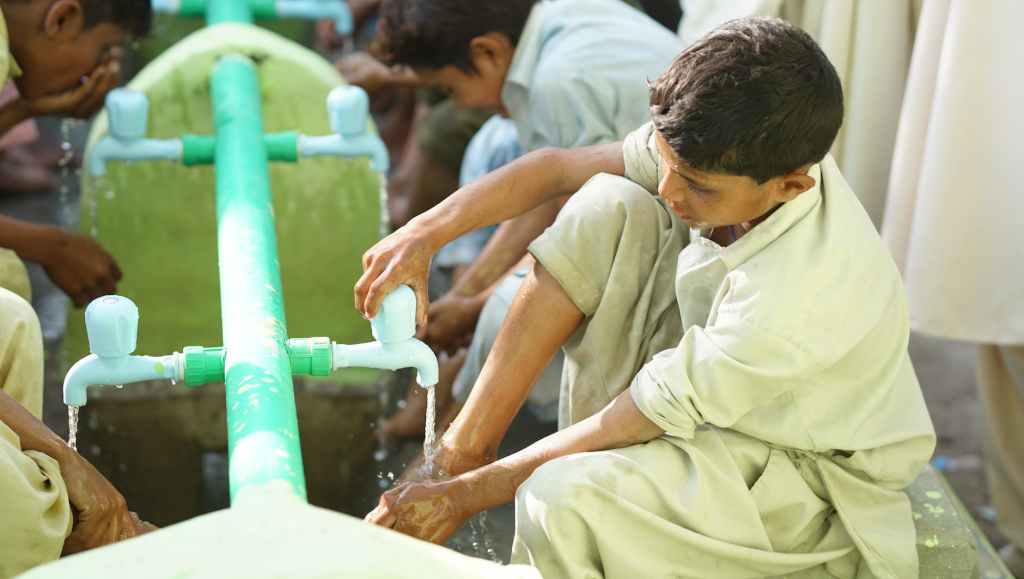
Allah has said “we have sent down from the sky pure water 25:48” Water is pure and it is purifying for other things. Water is of many types, from the well, the sea (salt), rain, etc. As long as its taste, color or smell has not been changed from its original state (i.e water added with Milk, honey, water from a dirty place i.e toilet, food coloring etc). We need pure water before we do ghusl or wudu and these are the characteristics in which we classify water which is permissible to use and that is considered useful for ritual purposes.
What makes water impure?
If something that is not impure is mixed with water and you touch it or consume it, it does not break your purity but it is not able to be used for ritual purpose (In example vinegar water is allowed to be consumed and it does not cause you to become impure in itself but not to be used for wudu). There are many verses in the Quran which speak about water and what derives from water (Rain, hail, etc). Entering the masjid should be done when you are not intoxicated until the effects ware off and when you are in a state of purity (not after sexual intercourse without bath, or whatever else breaks your fast/purity).
The prophet ﷺ made dua
“O Allah , separate me from my sins as You have separated the East from the West. O Allah, cleanse me of my transgressions as the white garment is cleansed of stains . O Allah , wash away my sins with ice and water and frost.” (Al-Bukhari 1/181, Muslim 1/419)
this reinforces the idea of needing and wanting pure water. Sea water is pure despite being salty in taste and all of the creatures within the water are halal to eat and this is unique in maliki fiqh that we eat whatever is in the water (alligators are a hybrid animal, it is generally disliked to eat predatory animals except if it’s a water animal, Alligator is halal because its a classified as from the water although not a solely water animal). ZamZam water is pure water and recommended for normal wudu and it is sunnah but it is disliked for you to use ZamZam water for removing impurity/ removing fifthly thing from oneself, it is not haram but it is disliked for that purpose. (References for what is pure water and what are its criterion: Al Kawaqib al durriyah page 63)
IMPORTANT POINT
If water is changed by something in its natural environment like dirt, salt, limestone, or something that lives within the water (algae, green plants on top of water,) or something that has naturally lived within the water for a long time and is not recently added to it (Wood, etc). Anything you can think of that was not placed by human beings in an unnatural fashion, some water is brown colored (inland river) some are saltier than others (sea water) and some water has more living things and has different natural smells (fish and creatures in it). It is more liked to find purer static water than waters that have living ecosystem producing natural smells. Ibn qadammah (Hanbali) mentioned that things you have no control of such as leaves and sticks and dirt within the water, or you cannot control that the river has a natural smell you can use it to make your religious practice easy. Ibn rushd a Maliki authority also says natural occurring things do not ruin the water for religious practice (Reference for types of natural occuring water sources: Al Kawaqib al durriyah page 74-75)
An example of impermissible water
The Ganges River is the most putrid filthy river in the world due to it being atrifically made polluted/impure due to hindu religious practices, it was made to be impure. Indian Islamic scholars say that river is not permissible due to its smell taste and color being changed. In the rivers of some nations you may see gas being dispersed upon the surface of the water (from the boats) and that is not permissible to use due to its color taste and smell being changed by unnatural sources.
The ruling on chemically treated tap water
Using tap water in a developed nation is permissible to use despite it being affected with chlorine chemicals to purify the water (which changes smell and taste) due to hardship (to make things easy for us) as all our water is from this source (tap) and we have no other (easily available) sources and to be able to practice religion with ease we can use this water. (off topic, impure chemical dirt is not allowed there’s certain type of dirt for tayyamum keep that in mind for when we reach tayyamum section of bab taharah!)
If a little bit of impurity falls into a vessel
If a little bit of impurity has fallen within the container of water but it has not changed the water in a significant way due to the contrast of the size of impurity in relation to the vastness of the vessel then you can use it but it would be disliked if you have a superior water source at hand. END OF LESSON HOT TAKES
Acid rain originates from the sky can possible be permissible as long as it not harmful to health, there is a hadith of a sick man who if he used cold water for ritual practice he felt it would harm his health, when he used the water it caused him to die from that and the prophet upon hearing that was not pleased and said you should have asked me about him using water in that condition. This likely also applies to mico plastics in water they are there but we ignore them because they are in small quantities not large enough to be detected.
Using previously used water for wudu
Water that was previously used for minor or major ritual use is disliked to be used again once it has already been used and especially if you have a renewable fresh water source. If the water has not been overpowered by something else then it is halal to use. If it has been changed we cannot use it, in example rose water is not able to be used as it has been altered and changed from its natural state. The mashur means famous or well-known aka mainstream position (in the Maliki madhab). The companions lived in a desert and would seek to preserve water but for most people living in modern societies do not have this issue. Mam Mutluq means water that is not changed and it is valid for use its meaning translates to “absolute water” mam musta’mil means water that has been used. In other schools such as shafi, hanbali and Zahiri they also held this same opinion. The companions would reuse the prophets wudu water and that is documented and they were not scolded or corrected for it.
The prophet said in a hadith
“Nabi (sallallahu ‘alayhi wa sallam) was in a red leather tent in Al Abtah. Sayyiduna Bilal (radiyallahu ‘anhu) stepped out with Nabi’s ablution water. Some Sahabah managed to get [the left over water of Nabi sallallahu ‘alayhi wa sallam and wiped it on themselves] and then sprinkled [whatever moistness remained on their hands on those who didn’t get the water]” (Sahih Muslim, Hadith: 503)
I believe it was imam ahmed who was buried with hairs from the prophet showing his elevated status that people would use his wudu water and be buried with things from him! The early Muslims would share the water that came from the prophet and pass the pitcher around but not in front of each other to expose the awrah. Taburdrud means coldness so using water to cool yourself off on a hot day, its sunnah to do ghusl on jummah even if your not in state of impurity, one view is that it’s makru to use previously used water to cool off and other views is that is not makru.

EVERY LIVING THING IS PURE HUMANS AND NON HUMAN CREATURES
Every animal is pure to touch, even animals that are not halal to eat such as a pig which is haram to eat but halal to touch within Maliki fiqh. If you would have touched a pig your wudu would not be broken but if you had eaten its meat it would be najas. Allah mentions in Surah isra verse 70 “Indeed, We have dignified the children of Adam, carried them on land and sea, granted them good and lawful provisions, and privileged them far above many of Our creatures.” It is mentioned in the Hadith (Reference page 80-81: Al Kaqawib al durriyah)
Impurity of those who disbelieve
Abu Huraira reported: He met the Messenger of Allah said “Glory be to Allah. Verily, the Muslim is not impure.” (sahih Bukhari 279) . The kuffar (Non Muslims) are called filthy in the Quran 9:28 “indeed the polytheists are unclean” but they are not filthy to the touch but rather they are spiritually impure and this is why they are not to be married and befriened and prohibited to live in the holy lands and prohibited from entering the masjids in which Allahs name is mentioned. Some people make the mistake to say the kuffar are physically impure by nature but the Quran is not refering to the physical although we know there are some physically dirty kuffaar but its not a rule. The kuffaar should not enter the Masjids of Allah especially not the Masjid al haram but not any masjids due to their impure spiriutal status until they become Muslims.
What comes from pure animals is pure and particulars regargarding the jalalah and haram to eat animals
Every animal is pure and what comes from them is pure such as their sweat, saliva, mucus, tears (from eye) as well as their eggs as long as it has not rotted.The milk from a living human being is pure, also the milk from an animal which is permissible to eat such as a cow or sheep or camel, Likewise the urine and feces of a animal does not break your wudu in maliki fiqh but you should still wash. You cannot drink the milk of a pig or horse or any animal that is not fit for eating. Animals that eat filth is called a jalalah is not fit for eating or taking their milk. These animals eat things which are impure and are not halal and what comes from them is not halal although you can touch them without breaking wudu.There is a hadith which states the Prophet drunk milk from pure animals ,”Anas bin Malik رضي الله عنه narrated: Once Allaah’s Messenger ﷺ visited us in this house of ours and asked for something to drink. We milked one of our sheep and mixed it with water from this well of ours and gave it to him.” [Sahih al-Bukhari 2407]
Eating the meat of predatory animals and which animal did the prophet make specifically haram?
Lions are allowed to be eaten but disliked to be eaten because it is a land predator which consumes other animals’ flesh for food and other animals similar to it. If you had drunk the milk from the predatory animals, it would be disliked but allowed. In the Maliki madhab it has the smallest amount of restricted foods of any madhab so I am inclined to say that even Frog is halal to eat. Horse is not allowed to be eaten “the prophet said do not eat donkey and he also said on the day of Khaybar (battle when mushriks attack Medina and tried to kill Muslims) said do not eat the meat of a donkey and that of a horse” 15 companions said it is makruh (Ibn abdul barr said this) in our day there is no dispute among the scholars in its prohibition.
What are the impure bodies?
The mayta (dead body) which does not have a circulatory system, the fly ant or worm is pure to eat (insects) and touching them will not break your wudu. In the shafi madhab swatting a fly breaks your wudu and causes the surface to be impure. The shafi madhab has the strictest rules of purity of all the schools, the maliki madhab does not have this issue we do not consider insects without circulatory system live or dead to break wudu and is halal to eat.
Dead body of that which does not having flowing blood
The dead body of humans other than that of a prophet is najas (impure) touching the body will violate your wudu, the great Shafi’i scholar Imam nawawi says the human body is not najas, but for the Maliki’s it certainly is najas Imam shafi also takes the same opinion. Also unclean is the dead body of any creature that has flowing blood, so small bugs with blood within them are impure. What is disconnected from the body that was sustained by the life of the animal is impure such as skin, horn, from the animal. Leather (animal skin) is allowed because it has been treated and changed from its natural/original state. Hair that is from a living or dead creature is pure, Allah says in Quran we can use this for clothing and shelter.
Urine of impure and disliked animals
The urine and feces of impure/disliked animals is impure and breaks the wudu if you come in contact with you (dog cat lion fox etc), but animals which are halal to eat their urine and feces does not break your wudu if you come in contact with them. In example if you are a farmer and you come in contact with manure you as you distribute it throughout the farmland does not break the wudu. Puss is impure and flowing blood of any source Is impure, not a small cut like a paper cut that causes a water drop. Intoxicants such as alcohol is impure to touch (possibly weed and other drugs as well.)
“Al many” and all other body fluids that arise from arousal and sexual contact will cause you to become majorly impure, if you touch the substance but did not engage in any act you will be minor impure and in need of a wudu not ghusul.
- Al madthy – Ejaculatory fluid which comes out during sexual enjoyment
- Al many – Ejaculatory fluid which comes out by gushing
- Al wady – white or clear liquid during urination
Ruling of the smoke/ashes of a burned najas thing and the different opinions of the ulema
Ashes and smoke of a najas thing is haram and that includes the body fluids, it is interesting because other commentaries say that the author of the izziyahs view is weak and that is not najis. Sheikh Sharnubi held the view that the fire in itself has a purifying effect which removes impurity. In books of Qawaid al fiqhiyyah such as Idah al Masalik you learn that changing the essence of a thing into something new changes in hukm so in the case of the fire which turns into ash it is transformed into a new thing therefor the Hukm changes making is pure as the reason for its impurity was removed.
Why was this question important for the Muslims?
The reasoning of the author was that people needed to bake bread, and when you make bread you would need fuel and some people would use dung to burn as a source of fuel and that would release tiny najas particles into the food and air to be consumed. The author said he was living in Egypt and it was widely practiced. Something that is widely prevalent and unavoidable might make following the fiqh in a ideal way very hard and in that instance you were allowed to eat to make ease because there is extreme hardship to follow the correct opinion. In Egypt many people are forced due to not having much sources of material to burn because they are living in a desert. If the Umum al-balwa would cease to exist then you are obliged to follow the correct opinion (Note: Umum al-balwa-widespread in society) (Note: The Maliki position of sexual fluid being najis is not shared in the shafi’I madthab.)
Differences of opinions in the madhahabs
Alhumdullilah for the differences among the ulema because it is a rahma for the people that Islam is not a rigid religion among the different madhabs and within the madhabs. Some people for example like in al azhar try to take this principle and make things too easy on the people. The caliph of the time of imam malik said to imam malik I want to make your madhab to be the law of the vast Islamic lands and Imam malik replied no, they the people of different opinions arrived to their conclusions in a legitimate means although he disagreed. The strongest opinion is that the fire purifies the najas things, and it is not haram to consume what was burned in fire.
Removing impurity from clothing (ijala means removal)
Is it wajib for the person praying to remove nijasa from their body and thobe and place of prayer (the place of prostration), thobe means any garment that is worn as clothing to prayer. If there is impurity in the vicinity but not directly where you are praying it does not spoil the prayer but it is obligatory to remove it if able with “mam ul mutlak” pure water. If you use anything other than pure water then your prayer is not valid. Impurity cannot remove impurity but only add to it. If najasa falls onto you as you are mid prayer then your prayer is void in that moment and must be made up once you are purified accordance to cleanness. If you realize there is impurity upon you from a previous moment that you had forgotten about then you must make up that particular prayer and cleanse yourself. If the time has passed and the prayer is over and hours have passed you do not have to remake a old prayer if you forgotten but rather only in the moment of the prayer and near its time frame. A barrier between the impurity and you is sufficient in example a thick prayer mat. Ibn Yunus al Sicilian who was from Sicily(many Muslims lived in Sicily in the past because ibn arafah launched a successful Jihad into Sicily he was a Tunisian Maliki of epic portions who lived during the hafisd period), ibn younus said you can put a covering on the ground and pray on that.
What constitutes a garment?
What constitutes a garment? Anything that you are wearing that would move with you in the movement of the prayer is considered your garment, this does not include a very long dropping garment that may hang and lag behind its wearer as it is away from you and does not move with you as your preform the aspects of the prayer. Al yugfi (afwan) means to be pardoned, Yasir (small amount) ad dum (dima blood), a small amount of blood is pardoned as long as it does not drip and the source of the blood does not matter in this case. If you find it in prayer and outside of your prayer also Yasir (puss, any type of puss), Yasir means less than the size of a dirham a silver coin, (like the size of a silver dollar?) If the effected area is smaller than that of a dirham then you must cease praying and go to cleanse yourself. (the dirham is the size of a mules lower leg according to classical terminology)
Over looked filth
A flea which carries blood can be forgiven as well as the results of splattering of impurity from in example rain that may drop and it disperses small spots of dirt and impurity on the bottoms of clothing. In the olden days there would have a indoor and outdoor shoes. In Europe they would use wooden shoes or wooden platforms on your shoes because the ground was full of mud (mixed with feces) and dirt to not untidy them. Regarding the word dirty it mostly refers to feces not fertilizer along as fertilizer has been changed from its natural state unlike feces direct in the mud without being changed. From the commentary of this book says small blood is pardoned but it is strongly preferred to clean yourself anyways.
The difference between sunnah and fadail
Sunnah is what the prophet routinely did in his life whereas fadail is logically deduced
The prophet said : verily actions are by its intentions. (Sahih found in bukhari)
Obligatory acts of wudu
- 1. Intention for the act
- 2. Washing the entire face
- 3. Washing up to the elbow (Its fard to go in between fingers)
- 4. Wiping of the whole head
- 5. The washing of the 2 feet up to the ankles
- 6. thoroughly rubbing body
- 7. continuity (doing it in all one motion)
Explaining the obligatory acts of wudu
The obligatory aspect for wudu is intention and you must have the intentions at the time of washing your wudu. Wudu is not just washing yourself but (Hanafis believe water on you at anytime gives you wudu even if you jump in pool) but in Maliki madhab you must do a specific set of actions and you must have a specific intention. The intention of the wudu is in your heart and in your mind. You must have intention when you first wash your face and at the moment not halfway through it nor too long before it. The context can make things easy if the context you realize there’s not a lot of time left and you start doing wudu, if you do not verbally say it in your head you know your intentions in your action within yourself. The actions of wudu are specific and not something you do accidentally it’s a very conscious act. Say bismillah when you start your wudu and that is sufficient you do not have to say “I am starting my wudu” Bismallah is clear intention with your mouth to start your wudu. Having intention is fard for doing wudu and it’s the first action in the wudu according to Maliki fiqh. You wash your face also in ghusul but you would wash more than that and have a different intention. If you wanna read Quran or do tawaf around the Kaaba then you must have wudu for those actions.
The sharoot al wajud of the obligations and validity of your wudu.
- The conditions for your wudu is as follows,
- intellect (conscious of your actions not insane people or children),
- 2. Someone being reached by the message of Islam
Requirements for being considered someone who has been reached by Islam (explanation of the 2nd condition of validity of wudu)
(dawah) once the dawah reaches you your supposed to be Muslim and this is something is debated in scholarships. I believe it’s the mashur of the maliki mathab that all the obligations of Muslims is meant to be practiced by the kuffar but they are headless. The reality is that al azhar says to be reached by the dawah they set extremely high standards that you have to be reached by true Islam, and the modern Muslims have failed to show true Islam because it must be the perfect tolerant Islam without extremism. The standard is too high and no one would be reached by the dawah. (in the Muslim lands most of them was minority Muslim until recently). Some people are not comfortable with kuffaar going to hell, they say all they have been exposed to terrorism and backwards evil people there for they did not get reached by dawah. The strongest opinion sheikh Zuhair, is that the bar is to be set at the lowest common dominator, if you set the standard too high then no one can reach the bar set, when the bar is low then you have to accept most kuffaar will be in hell. If you know Islam exist and know about the shadah then you have been reached by the dawah even if they had saw corrupt Islam then they have been reached by the dawah. They must except Islam or they will be in hellfire and if they do not they will be in the hellfire. Ignorance of the law is no excuse you must be judged. A sheikhs said “if there are any of those people that still eat flesh and do not have electricity then its safe to say they had not been reached by the dawah” If you are not living in a remote tribe you must act upon the knowledge of islam or you have wronged yourself.
You much wash the entire face, What constitutes the face?
From your hairline to the end of your chin/beard. (where the facial features are located and the top of hairline to bottom of chin) also what is between the two ears. Imam Ali RA was balled, the Shia do not represents him accurately (they show him as feminine Persian man) he was balled with very long beard. If you are balled or balding, your hairline has moved from its original state or you have no hairline at all you should wash until the point of your natural hairline if you used to have hair or where the average hairline would be present. You will wash your head later in the wudu do not worry. The beard should washed until the end of the longest hair in the beard or the chin if you are without a beard. When washing your face you must wash the outside of your ear, washing the inside of the ear is a sunnah and not obligatory then after you follow your jawline and you have washed your face properly. If you have wrinkles on your face in older age or on your forehead in your youth you must wash within the wrinkles/skin fold. If you have a scar that depresses the skin then you do not need to wash within the scar with finger but rather just wash it and the water will reach it. If you have a mark on your forehead from excessive praying then you should be sure it would be washed. (the zabib rasian in Arabic) (some with go to great efforts to get a zabib, or cut their forehead for the appearance of a zabib and this is not proper Islam) In the city of Qom, the ground water under Qom is salty and they get water from that source and long term exposure can create hairless so most the Shia “ulema” have balled heads and they have become like ALI who they base their religious ferver upon and idolize in that respect.
Washing the lips, between the hairs of the beard
When your doing wudu you can stick your lips out slightly to wash it you eat with your lips and what is between the two nostrils must be washed (monkril is nostril) (in between nostril is the comunella). Taklil is to run your fingers through something, if you have a beard then taklil your fingers through it but if your beard is thick then you simple wipe across it. Whats the difference between thick and thin beards? If you can see the color of your skin underneath the beard then you must run your fingers through it, if you cannot you do not need to do taklil and this favors light skin people. If your beard is patchy in example then you do taklil on the short parts and you rub over with the hands the long parts. If the hair is on your cheekbones and higher up on your face then you treat that hair as skin and wash it and its recommended to shave it (possibly?)
washing forarms and between the fingers
Wash your forearms until your elbows and lock fingers in between. In Arabic the word yad (hands) means the entire arm and hand is a yadd which can be broken down in into small parts. In Russian the used the same word for arms and legs as parts attached to your body. When your wash in between the fingers what matters is that skin touches skin from any part of the hand. If you are wearing a ring you do not have to remove it if you make sure water touches under the ring. You can move the ring back and forth to wash it properly. It would be easier to remove it but you are not obliged to do that.
Wiping over the entire head and opinions of different uelma
Is wipping over the entire head, al walulu, what begins from were the face begins (up to your hairline) to the end point of your chin/beard. Jumjummah (end of skull, where the spine and skull meet) what is the deleel for this? There is ayat of Quran for this. It is mustahab (recommended) to do this with new water each time. It is disliked to use this used water (dipping hand back into the used water that is dirty). Women who would be turned off from doing wudu and would neglect prayer can wipe only a part of it (this is the opinion of Imam shafi.) Wiping over the whole head is a maliki thing and not from the Hanafi/shafi’I schools who require you to only wipe a part of it. The maliki schools is stricter on the point. Whoever has done wudu and then is cutting his nails or cuts his hair does not need to wipe/wash those places once done. Some opinions is that you must need to rewash these areas once you have cut these places. There are more differing opinions on the beard because there is different rules for the beard weather it is small beard or large beard and if the skin can be seen underneath. That is the view of the maliki school. (you do not need to redo wudu after cutting nails) Anything that is from the keratin source hair/nails is not an issue. The majority of the Maliki school and hanbali school say you must wash the entire head in the fard wudu. Sheikh ibn rush al jid say ssomeone who leaves off part of the head is like someone who left off washing part of the face and part of the yadd (arms) this is also the opinion of Imam Ahmed. (Ahnaf – up until equal top of the head (1/4 of the head) Shafe – a few strands of hair).
The 5th aspect of the wudu is to wash the foot
( )/ankle (kaab) The ankle is the bone the sticks out above the feet. Nudibah means its recommended that you wipe between your toes, in the previous lesson we mentioned wiping in between the fingers. If you are leather socks you can wipe over leather socks provided that you washed them before going into the sock. The Maliki school is more strict with washing the feet and are less accepting of modern shoes and modern cotton socks and believe you must have the actual kuff Leather sock. We will get into this later into the book. Wiping in between the toes is preferred and correct and is not too hard upon the young men perhaps the older men so try to wipe in between the toes where as wiping in between fingers is a must but the toes is just preferred. It is recommended that you start from the right limb and the pinky toe/finger (al khinsar).
6th aspect is rubbing
6th is rubbing. This is passing the relevant parts of the body with water, this does not need to be done with flowing water from the tap or stream. If the hand is wet then that is sufficient to rub your relevant limbs, rubbing does not need to be explained deeply as it is obvious on how to rub. The scholars have written that its absolute necessary that it be your hand or palm but rather any skin from your body for an example you can use your feet to rub the other foot or the sides of your hand to rub the other hand.
The 7th aspect is continuity
The 7th part is Al muwalatu (continuity) continuity meaning to do all of the motions of the wudu in one go. That means without a significant pause in the actions. There was a man who stopped doing wudu and left to do something and the prophet said to continue the wudu from where he left off after he had stopped provided the last thing that you had washed had not become dry. If you washed your face and hands then head and you left to answer the door or pick up phone call, when you are finished with that you can continue doing your wudu provided that your arms and body had not dried within that time period.
The opinions of great scholars who had madhabs that fell out of practice
According to the old school of imam shafi’I and imam awza’i he was a scholar from lebnon and he created his own madhab which fell out of practice (Although being valid). Sufyan al thawri and imam al laythi are more imams who had schools who fell out of practice. They agreed on the al muwala of the wudu. Imam abu hanifah and ibn zahir did not make it a condition to the have continuity and proper order in order for it to be considered valid. There was a minority view of Maliki scholars who also held this view but the strongest opinion in the maliki madthab is to do it in order and without stopping for a significant amount of time. From Sheikh Ali munufi book al muqaddimah al izzayah with commentary
Today we look at sunnan acts of wudu, (sunnan al wudu) The sunnan acts within wudu are 8
- 1. The first is to wash your two hands before you put it into the water pitcher to prevent it from dirtying the water although it would be possible to still use it inshallah. (in the old days they did not often have piped water), wash the hands separately and you must have the intention for wudu, The student and companion of Imam Malik Ibn Qassim said that you can wash the hands together and that is not blame worthy.
- 2nd. washing of the mouth, to put water within your mouth then you splash it around to remove impurity then you let it out.
- The 3rd is to rinse the nostrils to remove impurities of the nasal passage.
- The 4th is to blow the water from the nostril (sababab, sababah index finger from left hand) by placing your left index finger on your nostril the lightly blow out the excess water. It is preferred that the water used would be fresh handfuls of clean water. The prophet said “Be through of your instinja unless you are fasting” the reason why is so that your fast isn’t disturbed by water entering your body. There another opinion that you use that right hand but I think the left hand is the correct opinion as taking things out is done with the left limbs, taking off shoe is done with your left hand first and entering the toilet with the left foot but to enter masjid you use right foot etc.
- 5. is to wipe over the ears, the inner part and the outer part using the index finger for the inner ear and the thumb for the outer ear, simukh means the ear cavity. There is a debate if the ear is part of the head or a separate body part, it is relevant because if you believe the ear is apart of the head once you wash your head following the head you would have wiped the ears.
- 6. is adding new water for wiping of the ears giving it a new batch of water specifically for the ear, it is mustahab.
- 7. is to return your hands from the end of your skull to the initial point of your forehead in a fluid movement. Someone with very long hair should this 4 times in a row, the prophet had long hair and it is well known. Modern Arabs tend to not have very long hair as their possibly due to European colonialism and modernism.
- 8. is to do the wudu in a orderly chronological order in a fluid motion. If you do not its ok but it is better than you follow the proper order and it is recommended to restart the wudu and follow the proper order if you make a mistake. The shafi’is and the Zahiri say it is not obligatory. They believe in taking the zahir the explicit direct meaning as you can get.
What is the ruling for leaving out a obligatory part of wudu?
if it is sunnah then you don’t need to redo your wudu as long as the fard aspects have been fulfilled. If you purposely preform a invalid prayer then the prayer is invalid. A man asked imam malik if a man forgot to wash within his nose before prayer what should he do, imam malik said he should add it to his next prayers.
The fadial acts in the wudu are 11
Sunnah is a step down from the fard and the fadial is a step down from the sunnan. It is thing you can add to perfect and improve upon your prayers. The fadial within the prayer has 11 points.
- The 1st is saying bismillah (tasmiyyah) invoking the name of Allah and if you forget to say it say bismillah in whatever step of wudu you are on. There is a debate whether you say Bismillah or bismillahirahman araheem, It is not obligatory but it is not harmful to do It but you should say bismillah in the beginning so that you signify your intention.
- The 2nd point is that you with your right hands index finger say the Islamic shahdah of faith and then say “May Allah make us among the repented pure ones” there are hadiths in Muslims and musnad ahmed, whoever does wudu and then says the shahahdah the 8 gates of paradise will be open for him.
- The 3rd is that you do not speak whiie in wudu. Thikr and dua is not including in this, it is referring to you chatting with your friends and making small talk. Make dua is commendable thing to do while in wudu and we see it listed above a dua you can say while doing wudu. Qadi iyaad wrote a sharh of sahih Muslim and said its disliked to speak in wudu.
- The 4th is to minimize the amount of water you use in wudu, there is no specific limit (one Mudd of water), but you must known according to your situation what is considered a lot of water for wudu. Your ghusul may be different. There is hadith about water and hadith about wasting in general and this is considered to be sarf, wasting is disliked in all circumstances. Even if you are on the shore of the sea you should still use minimum reasonable amounts of water. This is a fadila that is forgotten about in modern times. Many Egyptians waste water and Pakistan is also a very water inefficient nation. The prophet and his companions were never wasteful. The tureage says emaan amaan(water is life), they are not berbers but they are the inner desert people and water is very important for them to survive.
- The 5th fadila is to brush your teeth with a wet or dry stick (miswak/siwak) provided you are not fasting (it is not haram but is disliked) the green aka fresh miswak is better than a older dry one. You can also use your finger to preform siwak if a miswak is not avaible. It is recommended to do it before the prayer. The prophet said if not for hardship then I would have made using miswak fard. It’s a sunnah before prayer and after wudu if your are fasting then It is preferred that you do not do this.
- 6. You must prefom wudu in a clean place
- 7. The water container should be on the right
- 8. Wash the right side before the left
- 9.start from the forhead
- 10. Arraging sunnah aspects together
- 11. washing the parts 3 times with the exception being the head
Wiping of the neck in the maliki madhab
Wiping of the neck in the maliki mathab is not apart of wudu within the maliki madthab, Imam malik did not see the people of medina wiping their neck. There is a poem which last 3 things disliked in your wudu. 1, Doing wudu within a bathroom, having awrah exposed.
Cleaning ones self of filth
What is Istinja?
Preforming istinja is wajib (obligatory) as you must be clean before doing any idadat. He describes it as washing of water from where the filth comes from. This is done in respect to everything that comes from the 2 passages except passing wind. Instija is not needed after passing of wind. You begin washing with the left hand and you poor water upon yourself until you are clean. After you are complete you can rub your hand over sand. This can be replaced with Istijmar, istijmar means to clean yourself with rocks (stones pebbles). This does not just have to be with stones but with other materials such what is impermissible for you to wear such as gold would be permissible to use with istijmar.
What is Istibra?
Istibra is cleaning yourself (private area) from excess urine. Istibra is wajib and you must do it, If a minuscule among of urine comes out after istibra it does not cause issue istibra is meant to be done 3 times to be sure you are clean.
The etiquette of the needs (bathroom). (atehj means I need) (qadahal hajja)
There are 14 etiquttes of the needs (using bathroom).
- 1. mention the name of Allah before entering the bathroom (Come back to finish this incomplete)
- 2. Enter with left leg first
- 3. squat filth
- 4. cover ones nudity until close to ground
- 5. rest upon the left leg
- 6. separate ones thighs
- 7. avoid a very hard surface
- 8. avoid stagnant water (non flowing water)
- 9. cover ones head
- 10. Do not talk (except in fear of life or property)
- 11. Avoid the direction of the wind
- 12. to veil oneself from the sight of people
- 13. to go far away from people that they cant hear
- 14. do not face ones back towards the qiblah,
Bathroom rulings
The athab of going to the washroom, istinja and istibra both being fardh. Wearing rings with the name of Allah or any of his name is not allowed in the bathroom as it is a filthy place. Sheikh al misri said when you enter the bathroom you enter with your left leg and you come out with your right leg. All things good start with the right limb and all those impure you preform with the left limb. Jalis means sitting/squatting or in a lowered position, this is for urine and defecation and it also depends on what you are doing and where you are. In some situations you can urinate standing up and squatting would cause you to become dirty but you are never allowed to defecate while standing up. 4th thing is to continue to cover your nakedness until you are close to the ground. The 5th is to lean upon your left leg while in a squatting position instead of the right as left is for impurities. The 6th is to spread your legs , the 7th is to avoid very hard surface to use bathroom.
The 8th is to avoid water which is stagnant water, stagnant water is water that does not flow in example a lake or a well in which the pollution would not filter out naturally. This is against the maslaha of the Muslimeen. It is forbidden for small body of water and strongly disliked for a large body of water. The 9th is to cover your ehad and the 10th is to not talk while you are in a process of using bathroom. When you are in process of using bathroom you do not speak even to return salam. It seems there is fitra to not speak while using the bathroom it is a strange and violated feeling to speak while using bathroom.
The 11th is to avoid the direction of the wind, or the burrow (The hole of a animal, jinn live within holes and you can earn their anger), One of the companions peed in the borrow of a animal and the jinn cursed him and it caused him to die within the hour and his corpse turned a unnatural color and it was known he died due to a jinn. In the city they said they heard a voice from within the well that gloated that they had killed a sahabi. The other places you do not use bathroom is places that people sit and walk passed and a river bank. To veil yourself from the eyes of the people in other words go far away from the people so that you cannot be seen due to distance. The 14th is to not turn your back towards the qiblah if your in a barrier such jungle or forest or even a house the ruling is disputed the author says the strongest opinion is that it is prohibited. In modern context the toilet cannot be moved so you must do the best with what you have.
Nawaqid ul wudu
- 1st is that you are a kafir, a person of riddah the opposite of a Muslim (Murtad) (Munafiq is to be kafir and pretend to be Muslim kufr is within your actions) Khalil ishaq al jundi said if you deny the fardh ruling such as saying we don’t need to pray then he is kafir this is author of mukhtasir Khalil. He said denying that is known in religion by necessity makes you are kafir. He mentions praying to stars or prostrating to a idol, even if they seem to have correct aqeedah they are kafir and their wudu is broken and they have no share in jannah
- 2nd doubt as to the existence of purity or the lack of purity of yourself provided you are not someone affected by ocd/waswas (whispering of shaytan). If you do wudu and began to doubt that your wudu was done or was done incorrectly or that you lost your wudu then you are obliged to redo it and the wudu is invalid. If you did it correct you have no reason to doubt.
- The 3rd thing to remove your wudu is hadif (similar to hadith) which means what removes from the 2 sabil (path) (like fisabilliah) such as what comes from your private parts or your backpassage, (qabl front, dubl is back). Anything from front or back will remove wudu
- 4th is (sababa is point) the first of it would be that touching someone or yourself that would bring sexual pleasure to oneself (your wife,slave) even if you do not intend to get sexual pleasure but you received it then wudu is broken and if you intended to get it but did not then your wudu is broken. If there are a sexual deviant such as a homosexual then they would also have their wudu broken, this does not include sight, if you see the sight of a woman then you would be sinful but wudu is intact unless you discharge from your front passage and that would be inpurity of the hadif not the sabila. Touching your mahram such as mother/sister or a child would not spoil your wudu unless you receive sexual pleasure from it (You should not)
Touching the private parts removes wudu
Touching your private parts with the whites of your hands or the sides of your hands removes wudu if your bareskin makes contact then the wudu is spoiled. The Maliki school is very strict on this issue provided you did it with no barrier meaning skin to skin contact. The ruling does not change it remains impure regardless if you did it on purpose or on accident. If you touched the male private with a barrier then the Wudu is not broken (the barrier can be thin or thick) as for females the inside of the female private part is what removes the wudu not the outer area. Laughing does not break wudu but to laugh does break your prayer (qarqahar) by laugh we mean to burst out laughing
Ghusul has to be done after these 4 reasons
- Ceassion of the Hayd (The end of menstrial bleeding)
- Post natal bleeding (After a child is born small amounts of blood is present)
- Death (when A Muslim dies his body is given ghusl one last time)
- Sexual impurity (After sexual stimulation and evacuation of bodily fluids)
How is the Ghsul preformed?
- 1st is intention when removing the impurity.
- 2nd ta’mim (root means am, generalizing) water all over your body
- 3rd rub all over,
- 4th rub your hair
- 5th do it within a reasonable time frame. Regarding the Ta’min it does not include the inner ear but rather the exterior not the interior. Washing the interior is sunnah and allowed but its not wajib but in Hanafi and shafi’I school of thoughts it is wajib to do so. That concludes the fard for ghusul within the maliki madthab.
The 4 sunnah acts of Ghusl
- 1 wash your hands first before putting it in a water vessel,
- 2 wash within the ears,
- 3 washing inside the mouth
- 4. Water within the nose
There is 7 fa’dail of ghusul
- 1st is your tasmiyyah saying bismillah,
- 2 removing fith that is on your body(this is not only physically removing fith but spiritually cleaning yourself if filth is on your body y ou cannot pray you must remove it to be able to pray),
- 3 complete your wudu as you would normally,
- 4 pouring water on your head thrice, the author writes with the presumption that you are using a water vessel, modern uelma of the maliki school say in a shower you put your head under the faucet or cusp your hand and let it fall onto your head.
- 5 you do the right side of your body before the left as you do everything in Islamic purity except the impure things.
- 6 You start from your upper body first then work your way down (head arms shoulders wrist).
- 7 minimize the amount of water you would use even if you have unlimited water source it is the sunnah to use small water. It can be advisable for you to wash your awra areas first so that you do not make yourself impure, it is a fadila to remove impurity first and if you do so you would not have to rewash that area again during ghusul. It is advisesable to not be seen while you are doing your ghusul.
Tayyamum (Purification without water)
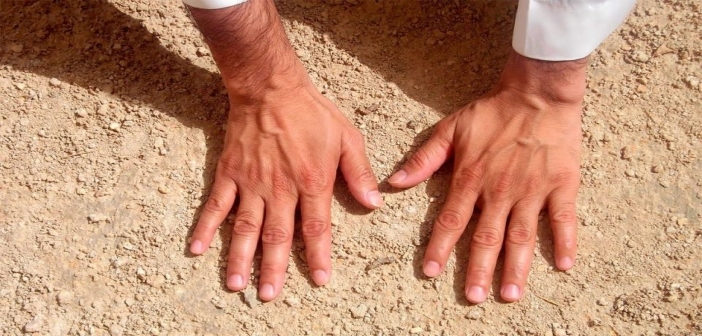
Tarab means dust, Tarhara tarabiyyah, dust purification it gives you license to pray in a circumstance in which you do not have access to water or you are unable to reach it although it is available. Perhaps you do not have enough water or you fear using the water would cause harm as you perhaps you would need the water later for drinking rather than using it for ghusl or wudu. Tayyamum gives you the ability to pray after being in a major or minor impurity in the case you cannot use water. Another case is if there is a water source that you do not have right to own such as a private well which is owned by a Muslim who did not give you the right to use then in your case you can use dirt as a replacement until water is available. Umar al khattab had a private well in medina and he would charge people to use it, medina was not a communist city.
6 obligatory act of Tayummum
- 1. Intention
- 2. Pure clean earth (it can be rock or hard surface)
- 3. Striking (darba) of the earth (1 striking is fard 2 is sunnah)
- 4. Wiping the face
- 5. Wiping up to the wrist (entire hand)
- 6. continunity (do it without long stopping)
4 Sunnah acts of Tayummum
- Tartib doing it all in order
- The 2nd striking (darba) of the earth
- Wiping the hands up to the elbows
- brining the dust to the hands and face
Tayummum does not replace wudu when water is found
Tayyamin is a last resort not a replacement for wudu, a once use non refundable ticket not to be done during every salat. If you do tayyamum for thuhur and pray then asr comes you must do tayyamum again, you cannot keep a continuous tayyamum cleanse unlike wudu with water which if you do not do anything that would break your wudu you can keep your purity for entire day. You can use tayyamum for jinazah that you have been chosen for and any prayer. If there is a situation in which there is lack of water and your in the desert and somebody died and the prayer needs to be recited. You can use it for all prayers except jummah unless in some circumstances you can do Tayummum in any nawafal prayer. Anything that spoils wudu will spoil your tayyamum as well. If water is near you must get the water but If its far then you can do tayyamum, a more modern scenario if your in the masjid and you wanna do wudu but there is a long line then you can do tayyamum instead due to time restraint. If you are in prayer and suddenly you come across water, if you are prayer and then you see water
Said al tahir pure earth
It is dust or sand or stone, pebbles other than sand and all parts of the earth provided its still in its natural state and not altered by human activity. Turab (sand) is the best thing to use as its clean and easy to tell if its been altered. You cannot use a precious mineral for tayyamun (Gold,Silver), you cannot do it from other naturally occurring materials like wood or carpet. In the commentary it is written you cannot do tayyamun over gem stone, emeralds and diamonds.
Tayyamun for the sick
The tayyamun of the sick is different than of the traveler as he as access to water but he is bedridden and cannot access it so for him he can use the wall for purification. Who ever does Tayyamun from a place that has impurity on it and he should make up the prayer if he is aware of it. Sand that has been used one person it is not prohibited to be used by another. With wudu water if its been used previously its called maam masta’maal and its disliked to be used again (except the water of the prophet) but batches of sand and dirt can be used again and again and even shared among the people.
How is Tayyamum done
How is tayyamum done, you first make the intention. The intention of the tayyamum is that you wanna do a specific prayer and remedy your major impurity but do not have the ability to do wudu. You gave the material a smack and shake the hands to remove particles then you wipe face and beard. Go from the top of your face then your whole face just like you would do in wudu. Then you wipe your arms starting from your fingers to your elbow using left hand to wash right hand first that includes inside the fingers too. If you are wearing a ring then you must remove the ring just like in wudu.
How many times do you do Tayamum?
Tayamum is only valid for one prayer so after the prayer is finish the next prayer would nessitate that you would do Tayammum until you find water or until the reason for doing Tayumum is removed.
Jabirya – wound cover
If someone has upon his limbs covered by wudu and upon it there is a wound and he is afraid that the water would delay or harm you getting better. If that is the case then you can wipe over the wound covering. You can wipe over your head bandage as well if you fear that your head would have gotten worse due to direct contact with water. If you are so covered in wounds and your wearing full body casting you can preform tayyamum instead of wudu upon the little bit of the body which is uncovered, perhaps a soldier after Jihad his body is scarred and harmed from fighting in the sake of Allah. If you washed over your bandages once it is removed weather it fell naturally or that you took it off, the wudu you had previously is not removed once you remove the covering. The significance of this is that in the previous chapter of tayyamum we are learning the exscuses to not do the full wudu, in this paragraph we are learning the khuf of doing wudu when only a part of the body is left in its natural state. You can wipe over it with water and if you cannot do that then you do tayyamum.
Wiping over khuf (Leather sock)
Khuf meanings the leather socks muslims are wearing which is which is inbetween a shoe and a sock. The prophet would sometimes just wipe over his khuf and not wash the entire foot, some Muslims take the opinion that we can translate that into whenever the foot is sufficiently covered you can wipe over it, The maliki school is more strict as usual and many scholars prefer that it be a actual khuf made of leather similar to the rasool or its not valid.
There are 8 conditions that must be met for wiping over the foot be valid.
- It must be made of leather if its not made of leather then it’s a jawrab and that’s not valid
- It should be made of a pure animal, it cannot be made from pig skin nor a pure animal which is not made dead from a halal method
- That be sewn and not just raw leather on the foot but shaped into a sock
- That is covers the area of the obligation (up to the ankle), also without any tear
- Must be practical to walk in not a unshaped leather as a cheat code for those who are lazy
- Must be worn in a state of purity if you are impure it is not to be wiped, it must be water base wudu initially not tayyamun then wear the khuf that would be invalid. Your entire wudu must be complete before putting on the khuf
- You are not in a state of disobedience while wearing the khuf, (hajj,) if you are a rebel to fight against the political authority then you cannot wipe over the khuf, if you are a slave who is running away from his master then you cannot wear khuf. In the commentary the status of the journey determining the status of the khuf is weak.
- Is that you do not wear it for fun, the wiping of the khuf is not for the one who does it for the sake of that you do it for making wudu easy out of laziness.
How do you wipe over the khuf what is liked?
In theory there is no time frame in which the khuf must be taken off, if you have done wudu then put on the khuf and you do not have a major impurity then in theory you could keep the khuf on until the next major impurty and we do not know how long that can be perhaps more than a week, until your major impurity you can wipe over the khu(sheikh sharnubi said you can wear it for as long as you want but you should at least take off the khuf once a week on jummah) the manner in which you do the wiping is that you use your right hand on top of the foot and your left hand on the sole and toes the risala of ibn abi zayd
Menstrual blood (Al Hayd)
The Hayd means in Arabic language menstrual bleeding the hard starts from the first drop of blood which would commence the hayd and from fajr to fajr of the next day is how you would count that. The duration of which is 15 days maximum provided it’s not blood that originates from birth or sickness or a wound etc, there is no minimum duration. This just means it’s a natural occurring bleeding referred to as menstrual bleeding. This section is divided in different 3 types of women such as the
- Saghir which is the young girl who is for the first time having hayd and she would not know her normal duration and amount so her hayd is 15 days,
- If she is an experienced woman which means she knows her hayd schedule then she would simply add 3 days to her normal duration so if its 5 days then she adds 3 days making it 8 then after 8 days she continues on as normal.
- The women with irregular hayd schedule
What does Hayd prevent?
If a woman has hayd she cannot have intercourse, praying, touching a complete copy of Quran in Arabic and she is not allowed to be divorced at this time (if you divorce a woman on her hayd the divorce is not valid).
What if 15 days has passed by and I am still bleeding?
If 15 days passes by then she can continue on with her life as if she is not upon hayd because after 15 days elaspe it can no longer considered hayd. If she bleeds after the 15th days for example 20 days 5 days more after the 15th days those 5 days of bleeding would be consider Istihadah bleeding.
The bleeding pregant woman
Post natal bleeding is the bleeding after child birth in which its maximum time of bleeding would be 60 days. In regards to the post-natal bleeding the woman is given 5 days if she is 2 months pregnant than she is given 15 days, if she is 3 months pregnant then 20 days if she is 6 months pregnant, she is given 30 days to bleed which is the max
Symptoms of the ending of post natal menses
- Dryness, if she adds a cloth and it is dry
- white discharge at the end of menses
A woman looks for signs for the end of menses at night and subh (Before bed and in the morning). Menses prevents prayer, fasting, divorce, touching/reading the Quran. entering a masjid and sexual contact. Note: the Quran mentioned in this is the Quran in the Arabic language not translations or fragments of the Quran in a incomplete form.
Post natal hemorrhage
Post natal hemorrhage is bleeding as a result of childbirth, the maximum duration for this is 60 days after 60 days has passed then you would not consider yourself as post natal bleeding anymore and the speech of the scholars indicate this is treated with the same fiqh rules as normal menses and Allah knows best.
 Authentic Maliki
Leave a comment